
I use Obsidian and Notion to keep what I have thought about and researched. Since I began using AI, organizing scattered writing, summarizing long documents, and sorting material by subject can all be finished with a short instruction. Time once spent doing that work by hand is now available for something else. It should feel like progress.
Yet as AI begins to organize my notes with me, doing any of the organizing myself slowly starts to feel tedious. So I hand over the whole task. The prose becomes clean, the categories sensible, the headings clear, and the result easy to revisit. Looking at the finished page, however, I can no longer tell what mattered to me or what I had wanted to preserve.
The information is still there. I am not.
Disappearing from a well-organized note
The problem is not that AI organizes things. Searchable text, consolidated repetition, and prose that another person can understand all make notes more useful. But a note does more than store information. It can also be a place to encounter a thought before that thought has a name.
Words may be missing. The subject may change midway through. There may be no conclusion, and the same idea may appear repeatedly. Those rough edges might be removed from a published text. In a private note, though, they show where attention caught, where certainty broke down, and what the writer was trying to say. Disorder is not always noise. Sometimes it is the trace of thought in motion.
Separating before from after
This led me to separate notes for AI from notes for myself. Notes for AI can hold source material, summaries, classifications, and knowledge prepared for later use. Notes for myself can hold an idea exactly as it arrived. They do not need an impressive turn of phrase or the clarity required for an audience.
This is not a choice between human and machine. What needs separating is the role, and the moment. First, I put down my own words. When those words need to become something that can travel outward, I ask AI to help organize them. AI does not have to stand at the entrance to thought; it can help at the stage when expression leaves the room. That order preserves both convenience and the feeling that existed before the polish.
Do not choose a folder before writing
Sidebars full of categories, ever more tabs, and carefully designed directory trees can be valuable for information management. When the thought itself has not yet taken shape, however, they can become the first obstacle. Choosing where to save something requires an early judgment about what it will become and how it will matter later.
Some things cannot be known before writing. Often, not knowing is precisely why we write. A note does not always need to assume that it will be revisited. It can be fragmentary, impulsive, and unfinished. Alongside the notebook that puts information on the correct shelf, we need an undemanding blank space in which to face ourselves.
Building the note app again
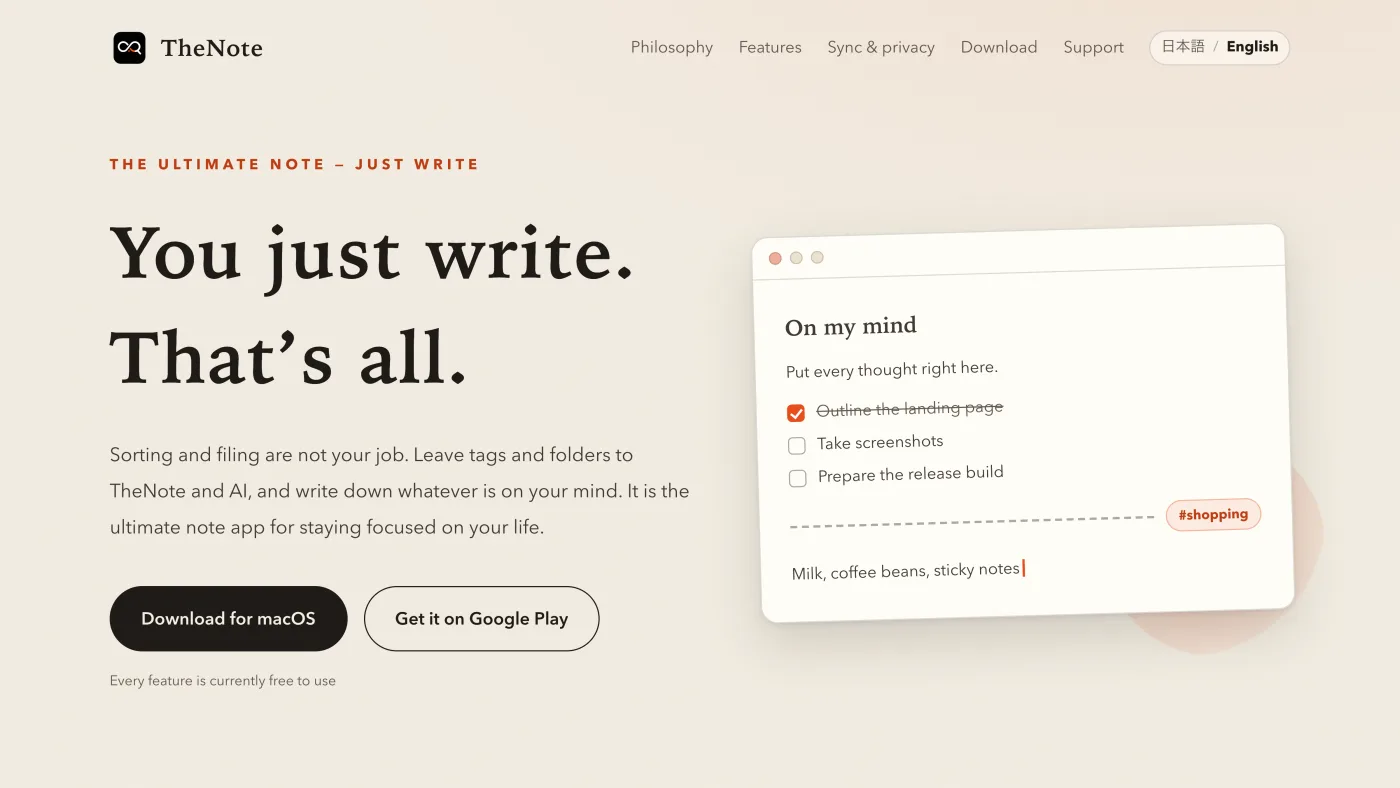
With that in mind, I am developing a note app again. Because it is a tool for every day, I want it to look beautiful, feel obvious to use, and remain fully operable from the keyboard. What is written on a computer should open on a mobile device, and a sentence begun on mobile should continue on the computer.
Perhaps I have simply returned to the starting point.
- Begin writing the moment an idea appears
- Do not demand a category or destination first
- Make every essential action available from the keyboard
- Continue the same note across computer and mobile
- Add what is necessary and remove what interrupts writing
I do not want to build another feature-rich information management system. I want a simple note that opens when an idea arrives and lets the writing begin. It is still unfinished. I am adding what it needs, removing what gets in the way, and allowing the tool to grow slowly.
Precisely because AI can polish our prose, we need somewhere to keep our words before the polish. Opening a note app should not only be an entrance to information management. It can be an entrance back into our own thinking.
TheNote
This inquiry is taking shape as a real product: a simple note app designed to keep attention on writing.
 Visit TheNote (opens in a new tab)